


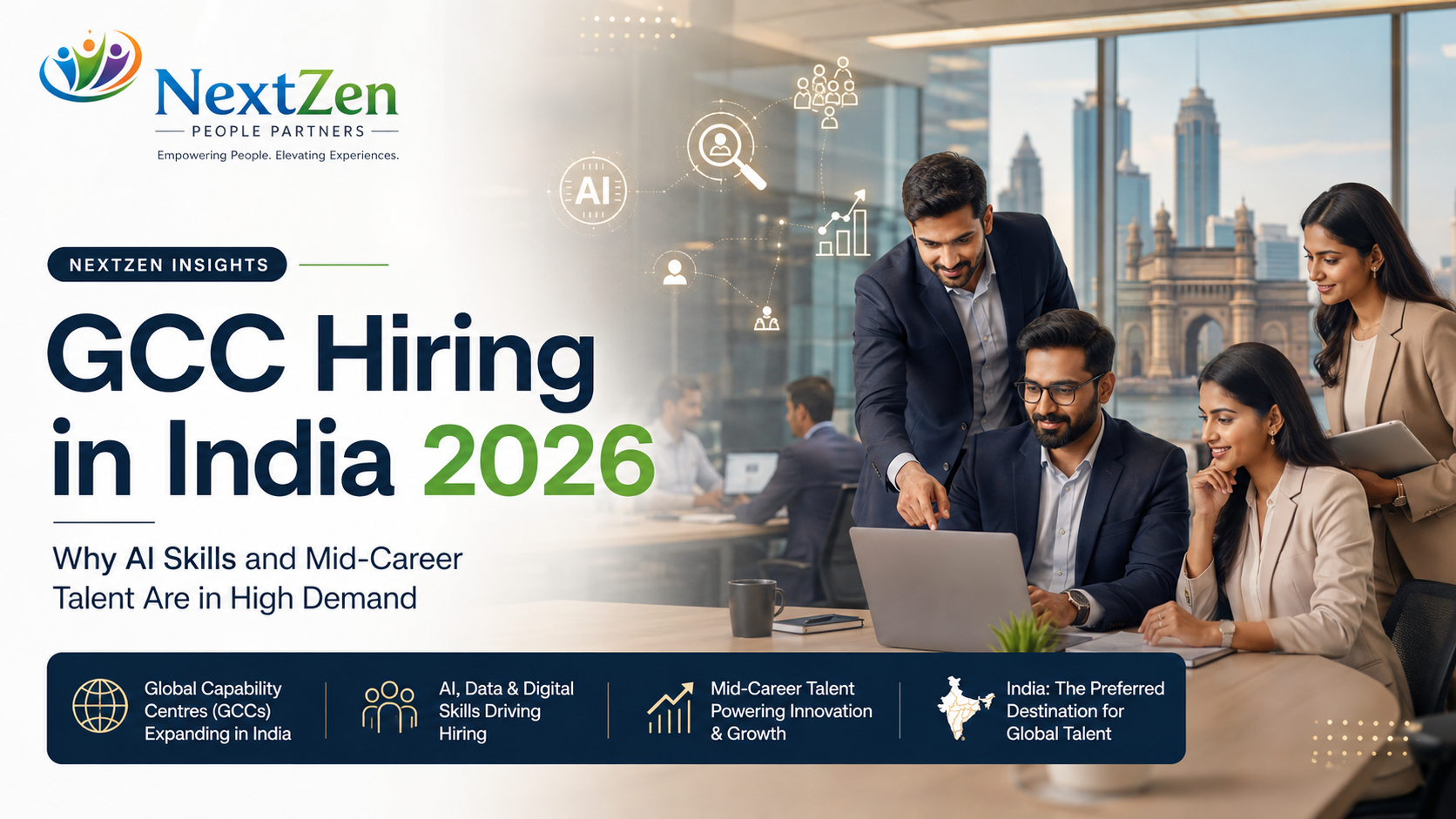
GCC Hiring in India 2026: Why AI Skills and Mid-Career Talent Are in High Demand
India’s Global Capability Centre ecosystem is entering a very different phase.
For many years, GCCs were primarily associated with cost optimisation, shared services, back-office operations and execution support. That perception is changing rapidly.
Today, many GCCs are becoming centres of technology development, product engineering, analytics, artificial intelligence, enterprise transformation and global business capability.
This shift is also changing what organisations need from talent.
Recent hiring data indicates that nearly two-thirds of new GCC roles created in India in 2026 require skills related to artificial intelligence, data science or intelligent automation. Professionals with four to ten years of experience also represent a significant share of GCC hiring, reflecting growing demand for people who can contribute quickly in specialised environments.
For organisations building or scaling GCC operations in India, the hiring question is therefore no longer simply:
“How many people do we need?”
The more important question is:
“What capabilities do we need to build for the future?”
Why GCC Hiring in India Is Changing
India continues to strengthen its position as one of the world’s most important GCC destinations.
The country now hosts more than 2,100 GCCs, while organisations continue to expand operations across technology, financial services, healthcare, manufacturing, retail and other sectors. Recent industry estimates show continued GCC hiring momentum even while parts of the broader white-collar employment market remain cautious.
What is particularly interesting is the nature of this growth.
GCCs are increasingly taking ownership of:
- global technology platforms
- product development
- digital transformation
- data and analytics
- cybersecurity
- engineering
- artificial intelligence
- enterprise operations
This means organisations need people who can do more than simply execute predefined processes.
They need talent capable of solving complex business problems, collaborating across geographies and contributing to transformation programmes.
AI Is Reshaping GCC Talent Demand
Artificial intelligence is one of the biggest forces influencing hiring strategies across GCCs.
According to recent 2026 hiring data, around 64% of new GCC roles require AI, data science or intelligent automation skills. AI, analytics and related digital capabilities are becoming increasingly important across technology, engineering, operations and business functions.
Importantly, this does not mean organisations only need AI engineers.
AI is beginning to influence roles across multiple functions.
For example, organisations may increasingly value professionals who understand how to combine:
technology expertise + domain knowledge + business understanding
A data professional who understands financial services may create more value than someone who only understands the technical tool.
Similarly, an HR, finance, operations or customer experience professional who can work effectively in an AI-enabled environment may become more valuable than someone relying entirely on traditional ways of working.
This is why GCC hiring strategies need to look beyond simple keyword-based recruitment.
Why Mid-Career Professionals Are in Strong Demand
One of the strongest trends in GCC recruitment is the growing demand for specialised mid-career professionals.
Recent hiring data indicates that professionals with approximately four to ten years of experience account for a large proportion of GCC recruitment. Industry reports also point to growing demand for experienced specialists who can contribute quickly to technology, innovation and enterprise transformation initiatives.
There is a practical reason for this.
When a GCC is scaling rapidly, organisations often need professionals who can become productive quickly.
They may need people who can:
- understand complex systems
- work with global stakeholders
- manage specialised projects
- mentor junior professionals
- navigate ambiguity
- combine technical and business thinking
These capabilities are often developed through real-world experience.
This makes specialised mid-career talent particularly valuable.
However, organisations also need to be thoughtful about how they assess this experience.
Years of experience alone do not guarantee capability.
A professional with six years of deeply relevant experience may sometimes be a stronger fit than another professional with ten years of less relevant exposure.
Skills Are Becoming More Important Than Labels
This brings us to one of the most important shifts in modern recruitment:
skills-based hiring.
Traditional hiring processes often begin with filters such as:
- degree
- previous job title
- years of experience
- previous employer
- industry background
These factors can provide useful context.
But they should not automatically become barriers that prevent organisations from discovering capable talent.
A candidate may not have the exact title expected in a job description but may still possess highly transferable capabilities.
Similarly, professionals from adjacent industries may bring valuable experience that strengthens innovation.
Skills-based hiring encourages organisations to ask a different question:
“What can this person actually do?”
Instead of relying only on labels, organisations can assess practical capability, problem-solving ability, technical expertise, communication and adaptability.
This does not mean degrees or experience are irrelevant.
It means they should be considered in context, rather than used as automatic gatekeepers.
What GCCs Should Look for Beyond Technical Skills
Technology capability is important, but successful GCC teams require more than technical expertise.
As GCCs increasingly work directly with global leadership teams, clients, business units and product organisations, human and business skills become equally important.
Organisations should therefore assess capabilities such as:
- problem-solving
- communication
- adaptability
- stakeholder management
- collaboration
- ownership mindset
- learning agility
- business understanding
For leadership and specialised positions, the ability to influence stakeholders and work across cultures can be particularly important.
An employee may have excellent technical knowledge, but if they struggle to communicate ideas, manage ambiguity or collaborate globally, their effectiveness may be limited.
The strongest GCC hiring strategies therefore combine technical depth with human capability.
Hiring Challenges GCCs May Face
Rapid GCC growth also creates recruitment challenges.
The first is competition.
Organisations are often competing for similar specialised talent in areas such as AI, cloud, engineering, cybersecurity and data.
The second challenge is hiring speed.
When businesses are under pressure to scale, recruitment teams may focus heavily on filling positions quickly.
But hiring fast and hiring right are not always the same thing.
Poor hiring decisions can create longer-term problems including:
- higher attrition
- low productivity
- repeated recruitment costs
- leadership bandwidth loss
- weaker employee experience
Another challenge is candidate expectations.
Experienced professionals increasingly evaluate organisations on more than compensation.
They may also consider:
- quality of role
- learning opportunities
- leadership
- flexibility
- career growth
- organisational culture
- global exposure
This means employer positioning becomes an important part of GCC hiring.
How Organisations Can Build a Stronger GCC Hiring Strategy
A stronger GCC talent strategy begins with clarity.
Before sourcing candidates, organisations should clearly define:
What problem will this role solve?
From there, recruitment teams can identify the capabilities that actually matter.
Instead of creating long job descriptions containing every possible requirement, organisations can differentiate between:
must-have capabilities
and
nice-to-have credentials.
Structured assessment methods can then be used to evaluate candidates consistently.
Depending on the role, this may include:
- structured interviews
- competency-based questions
- practical assessments
- technical discussions
- scenario-based evaluation
Organisations should also build talent pipelines before positions become urgent.
Specialised hiring often takes time.
Developing relationships with relevant talent communities, professionals and recruitment partners can make future hiring significantly faster.
The Role of Talent Partners in GCC Growth
As hiring becomes increasingly specialised, organisations may also benefit from working with recruitment partners who understand both talent and business requirements.
The role of a talent partner should not simply be to send a large number of resumes.
The real value comes from understanding:
- the role
- the business context
- candidate motivation
- skill relevance
- market availability
- compensation expectations
- long-term fit
Quality of shortlist matters more than quantity of profiles.
This becomes especially important when organisations are recruiting niche, leadership or specialised mid-career talent.
The NextZen Perspective
At NextZen People Partners, we believe the future of GCC hiring will increasingly be defined by capability, specialisation and human judgement.
Technology and AI can make recruitment faster.
They can help organisations source, screen and analyse talent more efficiently.
But hiring decisions still require a deeper understanding of people.
Motivation, adaptability, leadership potential, communication and long-term fit cannot always be understood through keywords alone.
The strongest recruitment model therefore combines:
technology where it creates efficiency
with
experienced human judgement where context matters.
For organisations building or scaling GCC teams in India, this balance can become an important competitive advantage.
Final Thoughts
India’s GCC ecosystem is no longer simply about operational scale.
It is increasingly about capability.
As organisations build global technology, AI, product and transformation teams in India, demand for specialised professionals is likely to remain strong.
The companies that succeed will not necessarily be those that hire the largest number of people.
They will be the organisations that build the right capabilities with the right talent.
And that requires hiring strategies that look beyond labels, evaluate skills more thoughtfully and keep people at the centre of recruitment.
NextZen People Partners supports organisations with Talent Acquisition, Specialist Hiring, GCC People Operations and practical HR advisory solutions.
If your organisation is building or scaling specialised teams in India, we would be happy to explore how we can support your talent requirements.